Cast Iron Beam Moulds Manufacturer,Supplier and Exporter in India
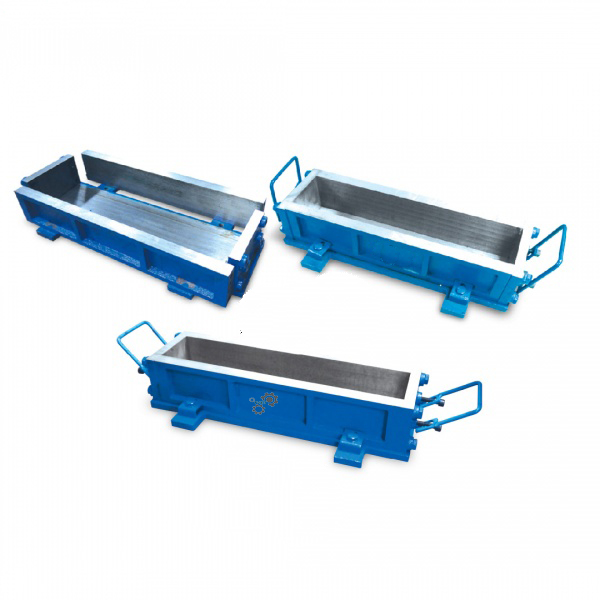
Product Code : TVT-CTE-10475
Cast Iron Beam Moulds are rigid, precision cast-iron moulds used to cast concrete beam specimens for flexural strength testing, offered in four standard internal sizes to suit different beam lengths and maximum aggregate sizes.
How It Works
Fresh concrete is placed and compacted into the mould (by tamping or vibration) to cast a beam specimen of precise, repeatable dimensions with true, parallel faces. After the specified curing period, the beam is demoulded and cured further (typically in a water curing tank) until its test age, when it is loaded to failure in a flexural (bending) test to determine the concrete's flexural strength (modulus of rupture).
Technical Specifications
| Parameter | Specification |
|---|---|
| 100 x 100 x 400mm Beam Mould | Overall 480 x 250 x 115 mm |
| 100 x 100 x 500mm Beam Mould | Overall 580 x 250 x 115 mm |
| 150 x 150 x 600mm Beam Mould | Overall 680 x 290 x 180 mm |
| 150 x 150 x 750mm Beam Mould | Overall 830 x 290 x 180 mm |
Applications
Used to cast standard-size concrete beam specimens for flexural strength (modulus of rupture) testing per ASTM C31, ASTM C192, IS 516, and EN 12390-1, with the 100mm and 150mm cross-section sizes covering the common maximum-aggregate-size ranges specified by these standards.
Related Products & Category
Listed under Concrete Testing Equipments. Related products: Flexural Machine and 100kN Hydraulic Flexural Frame.
Frequently Asked Questions
Which beam size should be used for a given mix?
The governing standard (ASTM C31/C192, IS 516) links minimum beam cross-section to the maximum aggregate size in the mix — larger aggregate requires the larger 150 x 150mm cross-section moulds rather than the 100 x 100mm size.
What is beam length used for versus cross-section?
The 400/500mm lengths pair with the 100 x 100mm cross-section, and the 600/750mm lengths pair with the 150 x 150mm cross-section, giving the correct support and loading spans for third-point or centre-point flexural testing.
What happens to the beam after casting?
It is cured (typically in a water curing tank) until its scheduled test age, then loaded to failure in a flexural testing machine or flexural frame to determine its modulus of rupture.
Request a Quote
For a price on the Cast Iron Beam Moulds, send us the quantity, the standard or test method it is for and where it should be delivered. Send an enquiry to Tvet Equipments.
Last updated: September 2026
.jpg)