Liquid Limit Apparatus Manufacturer,Supplier and Exporter in India
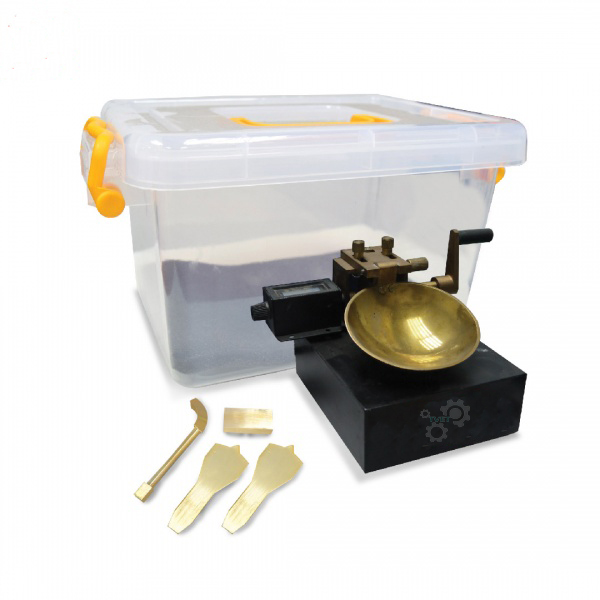
Product Code : TVT-STE-10555
The Liquid Limit Apparatus is the classical Casagrande instrument used to determine the moisture content at which a fine-grained (clay/silt) soil transitions from the plastic state to the liquid state — a key Atterberg limit used in soil classification and geotechnical design.
How It Works
A pat of prepared soil paste is placed in the brass cup and a standard groove is cut through it with a grooving tool. The cup is then raised and dropped repeatedly through a fixed height using a cam-and-crank mechanism until the groove closes over a length of 12mm; the number of blows required is recorded against moisture content. Tvet Equipments offers this instrument in two operating modes: a hand-operated version driven through a crank, and an electrically operated version that delivers a standardised 120 blows per minute as required by the test method.
Technical Specifications
| Parameter | Specification |
|---|---|
| Test Method | Casagrande grooving method |
| Available Models | Hand-operated (crank) and Electrically-operated (120 blows/min) |
| Product Dimension | 220 (L) x 168 (W) x 134 (H) mm |
| Case Dimension | 215 (L) x 215 (W) x 134 (H) mm |
| Approx. Weight | 2.5 kg (4.7 kg with carrying case) |
Applications
The Liquid Limit Apparatus is used in soil mechanics laboratories to determine the liquid limit of soil as part of the Atterberg limits test, governed by IS 2720 (Part 5): Determination of Liquid and Plastic Limit and ASTM D4318: Standard Test Methods for Liquid Limit, Plastic Limit, and Plasticity Index of Soils. The liquid limit value is fundamental to soil classification (IS 1498 / ASTM D2487 Unified Soil Classification System) and is widely used by highway, foundation and geotechnical engineers to assess subgrade suitability and compressibility behaviour.
Related Products & Category
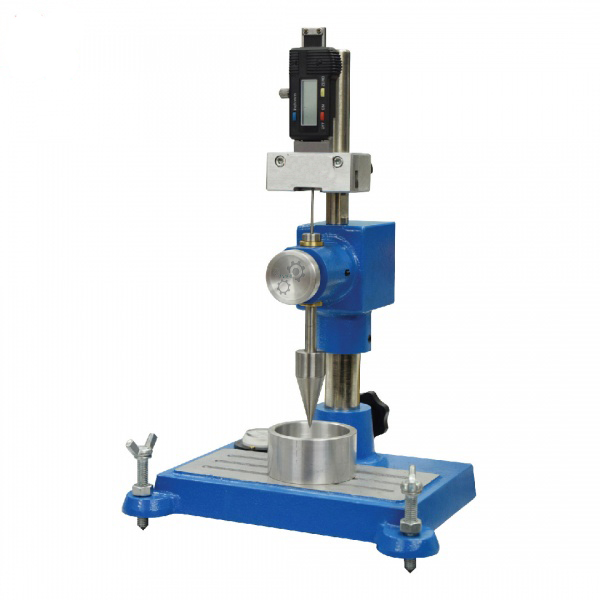
Browse the full Soil Testing Equipment range, or see Motorized Liquid Limit Apparatus and Advance Automatic Digital Cone Penetrometer.
Frequently Asked Questions
What is the difference between the hand-operated and electrical models?
The hand-operated model is driven manually through a crank handle, while the electrical model runs at a fixed 120 blows per minute as specified by the standard test method, reducing operator-induced variability.
Which standards govern the liquid limit test?
The test is governed by IS 2720 (Part 5) in India and ASTM D4318 internationally, both of which specify the groove-closure criterion and blow-count procedure.
Can this apparatus be used alongside the cone penetrometer method?
Yes — many laboratories run both the Casagrande and cone penetrometer methods for cross-verification; Tvet Equipments supplies both instruments.
Request a Quote
To get a quotation for the Liquid Limit Apparatus, tell us the test standard you work to, the quantity, your power supply (voltage and phase) and the delivery location. Request a quote from Tvet Equipments.
Last updated: September 2026