Relative Density Apparatus Manufacturer,Supplier and Exporter in India
Product Code : TVT-STE-10583
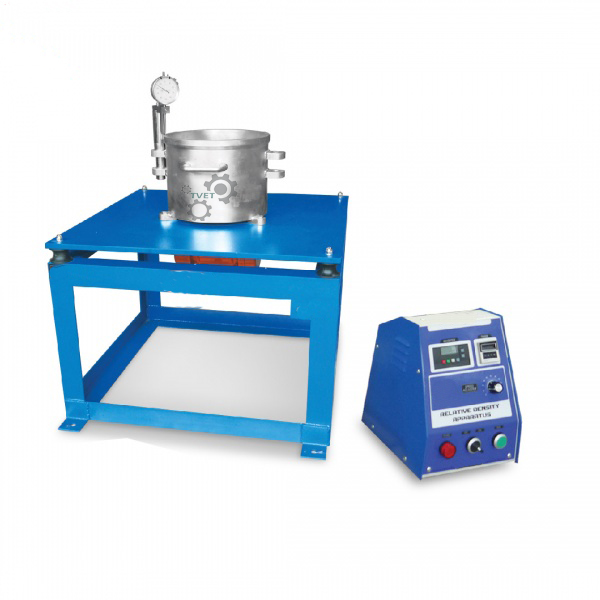
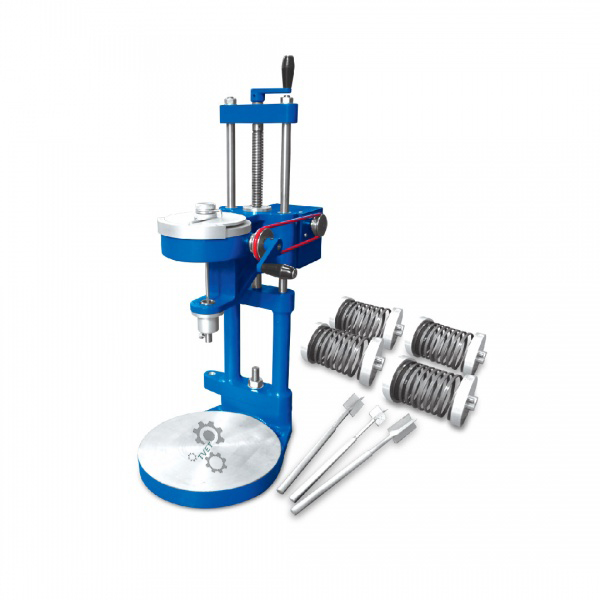
The Relative Density Apparatus is a vibrating table system used to determine the maximum and minimum dry density of cohesionless materials such as sands and gravels, from which the relative density (density index) of a soil in the field can be assessed.
How It Works
A mould filled with cohesionless soil is mounted on the vibrating table and subjected to a controlled vertical vibration at a set frequency and amplitude, compacting the material to its maximum achievable density; the minimum density is separately determined by careful loose placement of the same material. Comparing a field in-situ density against these maximum and minimum reference values gives the relative density (density index), a key parameter for assessing the compaction state of granular soils. The table's vibration frequency and amplitude are both adjustable to suit different mould sizes and material gradations, and moulds/accessories are supplied separately to match the required test standard.
Technical Specifications
| Parameter | Specification |
|---|---|
| Table Size (Vibrating Table Only) | 892 (L) x 762 (W) x 558 (H) mm |
| Approx. Weight | 330 kg (including ASTM & EN compliant accessories) |
| Power | 220 V, single phase, 50/60 Hz |
| Vibration Frequency | Up to 3600 RPM (max.) |
| Amplitude Range | 0.05 to 0.64 mm (adjustable) |
| Accessories | Supplied without moulds/accessories — ordered separately |
Applications
This apparatus determines the maximum index density per ASTM D4253: Standard Test Methods for Maximum Index Density and Unit Weight of Soils Using a Vibratory Table and the minimum index density per ASTM D4254, corresponding to IS 2720 (Part 14): Determination of Density Index (Relative Density) of Cohesionless Soils. Relative density results are widely used to assess the compaction adequacy of sands and gravels in embankments, backfills and granular subgrades, where standard Proctor compaction is not applicable to free-draining, cohesionless materials.
Related Products & Category
Listed under Soil Testing Equipment. Related products: Sand Density Cone Apparatus and Automatic Proctor / CBR Soil Compactor.
Frequently Asked Questions
Why use a vibrating table instead of a Proctor rammer for these soils?
Cohesionless sands and gravels do not compact well by rodding or rammer blows; vibratory compaction on a table gives a more representative maximum density for these free-draining materials.
What does relative density (density index) tell an engineer?
It expresses how densely a granular soil is compacted relative to its laboratory-determined maximum and minimum density limits, indicating whether field compaction meets the required density index.
Which standards apply to this test?
ASTM D4253 (maximum index density) and ASTM D4254 (minimum index density) apply internationally, with IS 2720 (Part 14) as the corresponding Indian standard.
Request a Quote
For a price on the Relative Density Apparatus, send us the quantity, the standard or test method it is for, your mains supply and where it should be delivered. Send an enquiry to Tvet Equipments.
Last updated: September 2026
.jpg)